


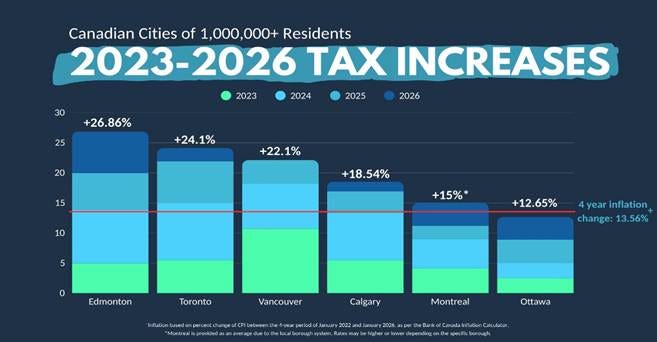
Infographic in Mayor Sutcliffe’s post on X on Feb. 27, 2026.
If you’ve ever wondered how Mayor Mark Sutcliffe manages to campaign without technically campaigning, consider this observation from former reporter – and soon-to-be official Kitchissippi ward candidate with a deep fluency in municipal affairs – Joanne Chianello: mayors campaign every day. You see, it is all in the framing. The Mayor’s comms team has been doing an excellent job in blurring the lines between informational and politically persuasive messaging in his public communication.
Sutcliffe’s team appears to have settled on a communication formula that works very well in the long pre-official campaign runway before May 1. Take a politically potent message –affordability, low taxes, “more for less” – wrap it in the more neutral language of public information, distribute it through mayoral comms channels (policy primers with his mayoral logo, social media posts, videos, earnest media updates), and let the voters connect the dots themselves. It is not subtle. It is disciplined strategic communication.
The Mayor’s recent X post featuring the infographic above on four-year tax increases is a case in point. See his language:
Many Ottawa residents are struggling to make ends meet. In the face of rising costs for food and housing, we can’t add to the financial burden of residents with big increases in taxes and fees. Other Canadian cities have seen property tax increases of 22% to 27% over the past four years. But in Ottawa, we’ve worked hard to keep taxes low… our tax increases have been below the average rate of inflation. We must continue to protect affordability for Ottawa residents.
For readers of this newsletter who are in the campaign communications business, you will note that Sutcliffe’s message is easily understood: other big cities raised property taxes 22 to 27 per cent. Ottawa? 12.65 per cent – below inflation. Bridge that to affordability, and you’ve married two of the most reliable concerns in any suburban focus group: taxes and cost of living.
It is elegant and effective “campaign” communication. The key political messages are nicely embedded in the “neutral” information.
Political Message #1: I kept your taxes down.
Political Message #2: I protected your household budget.
The tacitly understood conclusion: you should vote for me.
And to be clear, the numbers are real. For homeowners worried about rising grocery bills and mortgage renewals, 12.65 per cent over four years landing just under inflation is reassuring. Especially when Toronto sits at 24 per cent and Edmonton north of 26. If you are an incumbent Mayor seeking another term, you’d be negligent not to highlight it.
But here is where understanding the techniques of political communication gets interesting. The politicization of Sutcliffe’s messaging lies not so much in what he says, which could get him in trouble if he criticizes his political opponents using City communication platforms. It’s in what he doesn’t. That’s the piece of classic rhetorical jujitsu.
There is no discussion of trade-offs in his infographic. No reminder that lower annual tax hikes often mean slower service growth, deferred maintenance, or creative accounting between reserves and rate-supported programs. No chart on what the City of Ottawa will not do. That omission is not an accident. It is the heart of strategic communication.
Because without the trade-off conversation, the mental math for the average voter is blissfully simple: Sutcliffe = lower taxes = affordability = good. In municipal politics, that equation is half the battle.
His mayoral challengers, Kitchissippi Councilor Jeff Leiper, Neil Saravanamuttoo and Alexander Lawson, will all argue that residents deserve the full balance sheet from their Mayor, not just the positive headline. Fair point. They do. But balance is rarely the point of political messaging in an election year. Persuasion is.
Now, does any of this break the City’s own rules? No.
Ottawa’s administrative policies on communication by Council members draw a bright red, bureaucratic line around the misuse of City resources for explicit campaigning. They prohibit promoting or opposing a candidacy with municipal assets. But, perhaps most importantly for the Mayor’s comms staffers, the rules do not regulate tone unless Sutcliffe proceeds to claim in an official document that he is Canada’s best mayor because he has delivered the lowest tax hikes. And he is not going to do that. But he is sure going to lead you to reach that conclusion by the facts he chooses to amplify and those he chooses to ignore.
Outside the 60-day blackout period during an election year, Council Members can communicate about City business. The Mayor trotting out an explainer on tax policy – even in a highly selective and therefore self-flattering way – is squarely within the City’s comms policy bounds.
Mayor Sutcliffe is not explicitly asking for votes in his X post. He’s not attacking his opponents. He’s not repurposing the City’s coat of arms or slogans. He is simply doing what incumbents have always done by presenting his policy decisions in the most favourable light possible, without alienating the voters (suburban homeowners) whom he cannot afford to lose.
That’s not a scandal. It’s politics.
And here is the part that irritates his critics the most, including Jeff Leiper who has vowed to tackle “spin” from City Hall: it’s very effective politics. As I have written previously, the Sutcliffe comms team understands that the vast majority of Ottawa’s low-information voters don’t read Budgets. They read signals. They hear “below inflation.” They see an infographic showing they have the lowest municipal tax increases. They absorb “protecting affordability.” The rest fades into background noise.
Whether that serves the public interest is a different debate, one his challengers will happily prosecute. But as a matter of communications craft, Sutcliffe continues to practice textbook incumbent messaging for an Ottawa mayor: inside the rules, tuned to suburban homeowners, usually one key pocketbook message, relentlessly repetitive and on brand.
In sales, they tell you to always be closing. In Ottawa municipal politics, Mark Sutcliffe is always campaigning even when he’s just “sharing information.”
Kudos to Sutcliffe’s team for their prowess in strategic communication. They’re very good at message framing – much better than Leiper’s campaign so far. They’re not hiding the ball. They’re just making sure you only see the part of it they want you to.
To be fair, Leiper is pitching something completely different to Ottawa voters: more transparency and accountability at City Hall. He is positioning himself as the anti-spin candidate. He says that he intends to show us the whole ball. He wants a contest of ideas.
But this is not the campaign game the Mayor is playing. Sutcliffe is not debating on an open field. He’s drawing the lines and deciding where the play starts.
Evan H. Potter
Jimmy was the king of campaigning on the public dime and that lesson has been well received and utilized by council. In 2007 when I moved here my councillour didn't spin sorry communicate much. 2 terms in it was full speed ahead. Between the virtue signaling and promotional posting it is difficult to know when they actually do what they are paid to do.
Jeff doesn't stand a chance unless he learns this lesson. His communications so far have been way too complicated. Neil is saying essentially the same thing, but in a much clearer way. Between the two of them he's showing himself to be a better candidate for the reality of politics.
Do the rules actually allow a mayor to put their personal logo on a city plan for rejuvenating the Market? Seems like a fine line to me.